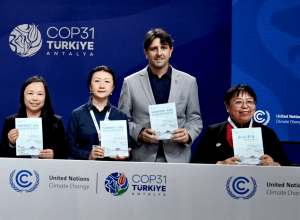
Antalya, November 16, 2026 — C Team today launched its new book “Harmony and Coexistence: Chinese Corporate Climate Action” at the 31st UN Climate Change Conference (COP31) in Antalya, Türkiye.
Published by China Economic Publishing House, the book embodies the Chinese philosophy of “harmony and coexistence” — the belief that climate action is not a zero-sum game but a path of mutual benefit linking humanity and nature, enterprises and industries, and China and the world. The book comprises three sections: Overview, Industry Initiatives, and Corporate Action.

The Overview section reviews China’s national “dual carbon” strategy and presents an analysis of a sample of 120 listed companies across six key industries — power, non-ferrous metals, chemicals, steel, building materials, and new energy. The data show that the share of companies proactively disclosing carbon emissions rose from 43% in 2021 to 80% in 2025, with 100% coverage of mandatory ESG disclosure across the six industries. An analysis of 136 corporate climate action cases collected from 2019 to 2025 reveals two major trends: a shift from isolated energy-saving measures to systematic solutions, and an extension from in-house emissions reduction to ecosystem-wide collaboration.
The Industry Initiatives section features three multi-stakeholder decarbonization initiatives: the “Carbon Needle” project led by the China National Textile and Apparel Council, which uses products as “probes” to penetrate supply chains and has completed carbon footprint accounting for 37 products and traced 78 suppliers in collaboration with Primark, Inditex, and Decathlon; the China Chain Store & Franchise Association’s coordinated action on food waste reduction, which has evolved from in-store surplus food donation to industry-wide association standards; and the “Enterprise Carbon Pioneer” project launched by the SEE Foundation and HSBC China, focuses on the automotive industry, working with professional partners to lower the threshold for SME participation in carbon management through providing accessible data tools and carbon data accounting training.The project facilitated the launch of Low-Carbon Supplier Evaluation Guide and the Guidelines for Setting Carbon Targets in the Automotive Industry, and trained over 400 participants from about 200 suppliers.
The Corporate Action section presents eight frontline practices: Through initiatives in recycled aluminium, China–Europe life-cycle carbon footprint data recognition for the JAECOO 7 SHS, and its Sustainability Responsibility Innovation Challenge, Chery is turning sustainability goals into practical innovation and lasting organisational capabilities, advancing a replicable model for corporate climate action; CALB is exploring a green industrialization pathway across the entire battery value chain through multiple initiatives, achieving a 25.31% year-on-year reduction in greenhouse gas emissions intensity amid production capacity expansion; Everbright Water (Zibo) Limited, which has developed an integrated “Clean Water, Green Power, Regeneration, and Unity” model; JA, which uses an integrated solar-storage and smart-control system to power a coral conservation station and support its desalination operations; Geely, which offers a Chinese solution for hard-to-abate sectors with green methanol; Modern Dairy, which created a low-carbon “farming-energy-planting” circular model; the State Grid Tongshan branch, which turned electric vehicles into mobile power banks for farmland irrigation; and Sinopec Hainan, which transformed existing gas stations into integrated “PV-storage-charging-discharging” green energy hubs. Geely’s “Yuanchun 001” — the world’s first methanol-electric vessel able to carry both containers and bulk cargo — is now in commercial operation.
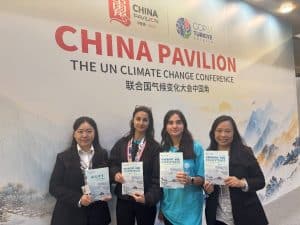
In his foreword, Li Penghui, director of the Public Communication Department of the Center for Environmental Education and Communications (CEEC) of the Ministry of Ecology and Environment of China, notes that these practices chart a clear progression in Chinese corporate climate action, from isolated breakthroughs to system-wide solutions. Yang Peidan, chief editor of the book, says, “As COP31 focuses on six priority areas — electrification, waste management, resilient cities, climate finance, green industrialization, and climate education — the corporate experience documented in this book offers practical, replicable models for climate action worldwide.” She also acknowledges Vanke Foundation, which has long supported C Team and CEEC in collecting and publishing corporate climate cases.
Publication Details
Title: Harmony and Coexistence: Chinese Corporate Climate Action. Edited by C Team. Published by China Economic Publishing House in November 2026. ISBN: 978-7-5136-8884-0.